
May 6, 2026, 10:54 pm

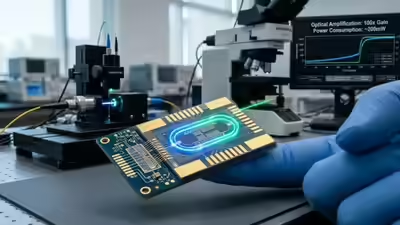

Stanford University researchers came up with an innovative optical amplifier about the size of a fingertip. This tiny device could change high-speed data communications by cutting down on energy use significantly. Traditional amplifiers tend to be large and consume a lot of power, but this new chip is different. It features a ‘racetrack-shaped’ resonator that recycles light, increasing signal strength by 100 times while using much less electricity. According to the report by Stanford University, this advancement opens the door for advanced photonics to enter portable, battery-powered gadgets like smartphones and remote sensors. By shrinking the technology needed for fibre-optic-quality signals, the researchers have successfully connected massive telecommunications systems with smaller consumer electronics; this promises faster and more efficient global connectivity in the future.
The main breakthrough with this chip is its ability to boost light signals by 100 times, all while using only a few hundred milliwatts of power, as noted by Stanford University. In the past, optical amplifiers needed a lot of energy and space, which restricted them to large data centres or undersea cables. However, this new device changes the game. Built on a thin layer of lithium niobate, it uses something called a ‘resonant’ architecture. So here’s what happens: light travels thousands of times around a tiny track on the chip. This process ramps up the intensity through stimulated emission, similar to how lasers work, but it’s incredibly energy-efficient for communication signals.
The researchers worked with lithium niobate, a material popular in the optics world because it can change light’s path when electricity is applied. The team at Stanford developed a new method called thin-film-on-insulator; this method allowed them to trap light more effectively than ever before. Thanks to this tight confinement of light, they managed to keep the amplifier effective, even when it was reduced to fingertip size. Shrinking the amplifier is essential for fitting these chips onto regular computer motherboards and mobile devices.
The chip doesn’t just boost internet speeds; it also requires very little power, which is a big deal for the Department of Energy’s ‘Green ICT’ objectives. Lowering the heat produced during data transmission is crucial for future 6G networks and sensors in self-driving cars like LiDAR. Since the chip can work with batteries, it might let drones or satellites send lots of data without adding much weight or using much power. This would help with government projects in space exploration and monitoring the environment from afar.
The Stanford team came up with a new design that tackles the common ‘gain-saturation’ issue in small amplifiers. They employed a looping resonator, which cleverly boosts the ‘interaction length’ of light without making the chip bigger. Instead of just passing through once, light travels through the gain medium multiple times. This allows it to collect more photons from a less powerful pump source, enhancing output and reducing the usual ‘noise’ that often interferes with signals in fast communications.