
April 27, 2026, 10:24 am

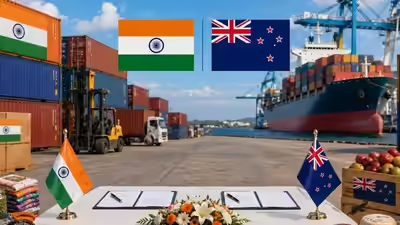
India and the New Zealand on Monday are signing the India-New Zealand Free Trade Agreement (FTA) in the presence of Commerce and Industry Minister Piyush Goyal and New Zealand’s Trade and Investment Minister Todd McClay. The agreement is expected to significantly strengthen economic ties between the two countries. It aims to double bilateral trade, provide Indian exporters duty-free access to the New Zealand market, and attract investments worth $20 billion over the next 15 years.A free trade agreement is a pact between two or more nations under which they agree to eliminate or substantially lower customs duties on a wide range of traded goods. It also seeks to reduce other barriers that may affect trade and investment between the participating countries.Ahead of the signing, Goyal on Sunday said that the free trade agreement with New Zealand,will open up substantial opportunities for Indian businesses, including leather exporters based in Agra.Goyal said that products shipped from India to New Zealand would enter the market without any import duties, creating major growth prospects for sectors such as Agra’s leather industry. He added that the pact would further enhance two-way trade, which currently stands at around $2.4 billion.Goyal was Agra alongside New Zealand’s Trade and Investment Minister Todd McClay. During their visit, the two ministers interacted with industry representatives from a range of sectors, including leather and sports goods.
Negotiations for the India-New Zealand trade pact originally began in 2010. After nine rounds of discussions, talks were put on hold in 2015. They were revived in March 2025, marking a fresh start to the process. The successful conclusion of the talks was announced on December 22, 2025.
At the same time, India has protected its domestic interests by withholding tariff concessions in several sensitive sectors. Items placed on the exclusion list include dairy products such as milk, cream, whey, yoghurt, and cheese; animal products other than sheep meat; and a variety of vegetable products, including onions, chana, peas, corn, and almonds. Sugar, artificial honey, and animal, vegetable, or microbial fats and oils are also excluded.The exclusion list further covers arms and ammunition, gems and jewellery, copper and copper products such as cathodes, cartridges, rods, bars, and coils, as well as aluminium and related products including ingots, billets, and wire bars.Merchandise trade between the two countries was at $1.3 billion in 2024-25. India exported goods worth $711.1 million, while imports from New Zealand amounted to $587.13 million during the same period.