April 30, 2026, 11:08 pm

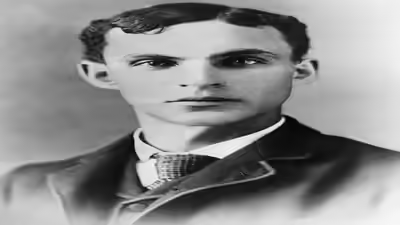
In many cases, we find a little bottle of super glue somewhere among our cluttered possessions, just waiting to come to our rescue. Its uses range from fixing a cracked handle on a coffee cup to repairing a favourite toy for a child, as it bonds quickly and firmly, creating an immediate seal. However, the individual responsible for bringing super glue into our homes did not intend for it to be used to mend cups or toys. Harry Coover had his mind on a different task when he developed super glue in 1942.During his time at Eastman Kodak, Coover headed a group trying to develop clear plastics for precise gun sights for the military; materials which would need to have optical clarity and strength. While experimenting on these materials, they stumbled upon a class of compounds called cyanoacrylates. Much to their despair, these substances turned out to be a nightmare for them. Not only were they not clear plastics, but they seemed to have a grudge against them by adhering to their apparatus and workbenches.Indeed, at that time, such a development was considered quite a disaster, not an innovation. Coover’s team was facing problems concerning optical technology during wartime, and such a quick-setting adhesive was considered a failure. Amidst the enormous pressure in 1942, the scientist turned his attention to other substances that were potentially useful for the army. More than nine years later and in a new encounter with the same substance, the whole world realised that such a laboratory disaster was, in fact, a turning point for concealing.Chemistry of a successful failureThe reason why the substance became so aggressive and unpredictable lay in the chemical features of the product. In accordance with one of the biographies written by MIT Lemelson, humidity was the key factor to consider. Almost any surface contains microscopic water molecules, and when cyanoacrylate encounters humidity, it initiates the polymerisation process.This causes the liquid to transform into a solid plastic mesh almost instantly. For a team trying to cast smooth and clear lenses for gun sights, this reaction was an absolute nightmare because the material would stick to the moulds and ruin the clarity.It was not until years later, around 1951, that Coover revisited the compound while looking for heat-resistant polymers for jet canopies. When a colleague complained that the substance had permanently fused a pair of expensive refractometer prisms, Coover finally saw the potential. He realised that the failure of his 1942 experiments was actually an incredible gift. The material did not need heat or pressure to work. It just needed the ambient moisture already present on the objects themselves to create a bond.
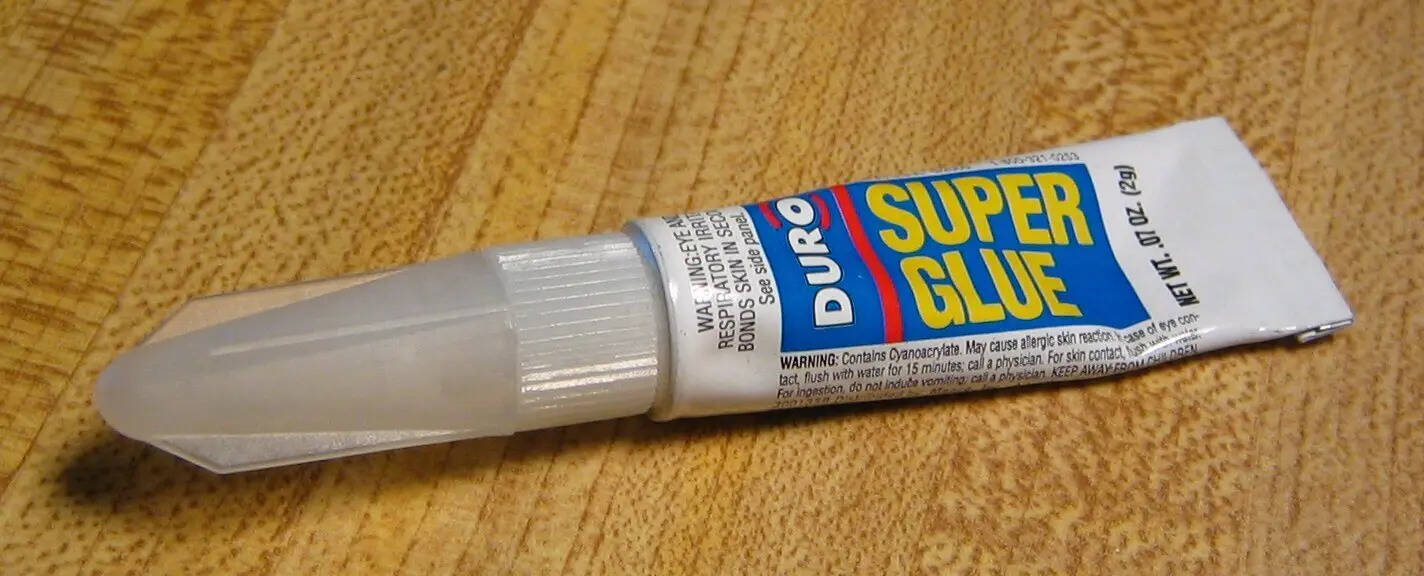
Years later, Coover realized its potential as a fast-acting adhesive. This accidental invention transformed how we repair objects, from household items to medical applications. Image Credits: via Wikimedia Commons
Reviewing these discoveries in The Laryngoscope describes how these adhesive products originated through research into materials used in gunsights. The article highlights the transformation of a problem in laboratories, namely the appearance of an unwanted substance, into a commercially available product, called Eastman 910, that revolutionised the perception of structure bonding. This is one of those classic stories when a seemingly fruitless endeavour in one sphere of life became extremely successful in a completely different area.Changing a problem into a world heritageThe story about super glue shows how the scientific mindset of noticing mistakes allows for making major discoveries. Had Coover ignored those undesirable samples in 1942, we would have been using regular glues that required many hours to harden until today. However, Coover was persistent in investigating this adhesive reaction and succeeded at last. The history of Cornell alumni records shows that this invention earned its inventor membership in the National Inventors Hall of Fame.It is interesting that by the end of the 1950s, a forgotten piece of plastic turned out to be an amazing tool for everyone’s use. It made its way to hospitals, where it was used to patch wounds without sutures, and factories, where it helped assemble electronic products. From such twists and turns, it becomes evident how innovation does not follow a linear path but takes a more unpredictable route, relying on new insight.Today, when we use super glue, we do not even think about its unusual history. However, it reminds us of our curiosity and our ability to discover the best solutions. An unfortunate event experienced by Coover in 1942 shows us once again how the most useful products usually turn out to come from nowhere. What was initially an unsuccessful attempt to create a gun sight became an opportunity to mend our broken world, bit by bit.