May 6, 2026, 3:32 pm

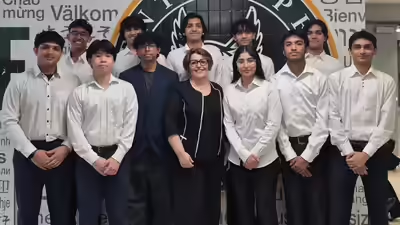
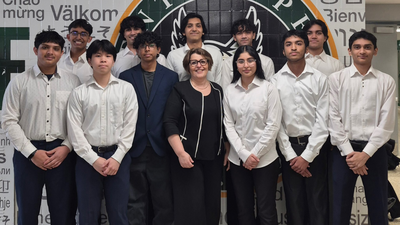
A team of Grade 12 students from Central Peel Secondary School in Brampton, Canada, has won the grand prize in the 2026 Gerard K. O’Neill Space Settlement Contest. The team included several students of Indian origin and defeated more than 23,000 students from 31 countries. Their project, titled Saoirse, proposed a self-sustaining space settlement for 10,000 residents at the Mars-Sun L2 Lagrange point, a stable region in space. Organised by the US-based National Space Society (NSS), the competition is considered one of the world’s most respected student aerospace contests. The victory also marked the first time a Canadian team won the competition’s top award.
Gerard K. O’Neill Space Settlement Contest is an international competition that challenges students to design realistic human settlements in space. Originally launched in 1994 as the NASA Ames Space Settlement Contest, it is now organised by the National Space Society.Participants are required to create detailed concepts for future habitats beyond Earth, covering engineering, artificial gravity, food production, energy systems, economics, governance, transportation, radiation shielding and long-term sustainability. Winning entries often resemble professional research proposals rather than ordinary school projects, with some submissions exceeding 100 pages.The contest is named after physicist Gerard K. O’Neill, whose influential ideas about orbital colonies inspired decades of research into human life in space.
The Brampton students’ project, Saoirse, imagined a large-scale orbital settlement capable of housing 10,000 people near Mars-Sun L2. Lagrange points are regions where gravitational forces between two large bodies create stable zones that spacecraft and habitats can occupy with relatively low energy requirements.The proposal focused on creating a fully self-sufficient colony with residential zones, agricultural systems, renewable energy infrastructure and rotating habitats designed to generate artificial gravity. Like many top entries in the competition, the project combined concepts from physics, engineering, environmental science and social planning.The team’s achievement earned them the contest’s grand prize along with a shared $5,000 scholarship and an invitation to present their work at an international space development conference.The winning team included Mahimn Patel, Muhammad Rehan Jafar, Lance Li, Aromal Mihraj, Rhythm Bhullar, Ved Joshi, Siddhant Vyas, Deep Patel, Aarsh Patel, Thanosan Prathifkumar and Neel Pathak.The contest attracts thousands of participants every year and is widely respected within aerospace education circles. According to official NSS figures, the 2026 edition involved more than 23,000 students globally, with thousands of submissions evaluated by judges.For Canada, the victory represents a milestone in international STEM competitions, with Central Peel Secondary School becoming the first Canadian institution to win the contest’s grand prize.