May 3, 2026, 2:05 pm

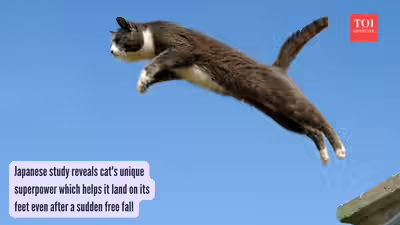
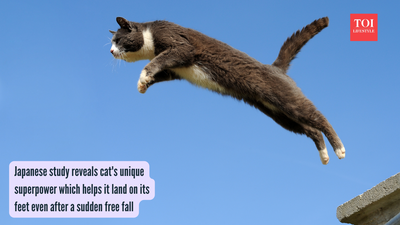
We have all seen cats jump and climb from trees, leap across home terraces, and tumble from shelves or chairs, but their paws always hit the ground perfectly, probably never amiss.Have you ever wondered why?Japanese researchers cracked the code, attributing it to a superpower in their spines. This isn’t any animated show running the magic, but physics and anatomy, saving whiskered daredevils daily.
A team from Yamaguchi University explained how cats twist mid-air to land on their feet, publishing their findings in The Anatomical Record. Led by veterinary physiologist Yasuo Higurashi, they examined the spines of five cat cadavers, testing torque, stiffness, and rotation in the thoracic (upper and middle back) versus the lumbar (lower back) areas.The most surprising part of the discovery was that the thoracic spine has a “neutral zone” permitting about 47° of twist with little resistance, while the lumbar spine remains stiff with no such zone. “These results suggest that trunk rotation during air-righting in cats occurs sequentially, with the anterior trunk rotating first, followed by the posterior trunk, and that their flexible thoracic spine and rigid lumbar spine in axial torsion are suited for this behavior,” the authors stated.
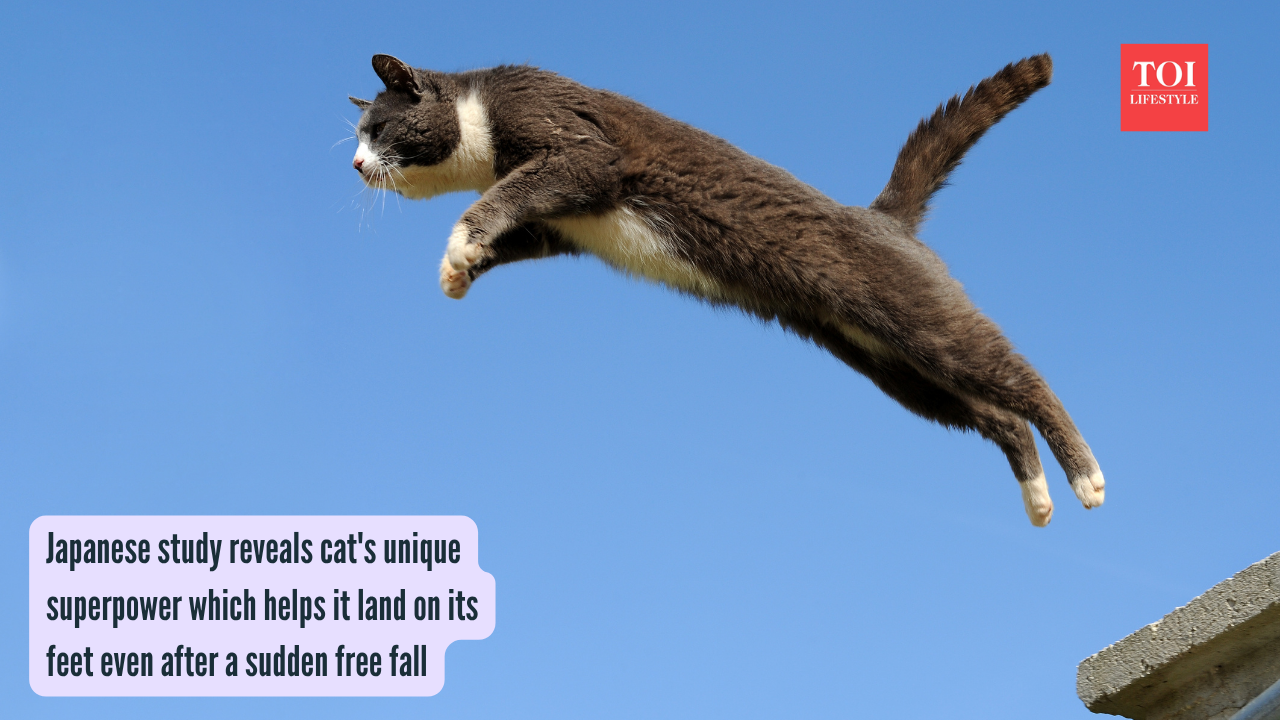
Representative Image
The front part of a cat’s spine bends easily to rotate the lighter head and shoulders downward first. The stiff rear spine then stabilises the body, preventing uncontrolled spinning. The thoracic area handles less maximum torque, sacrificing some strength for greater flexibility.
This resolves the famous 1894 “falling cat problem”. It is to be noted that objects in free fall cannot rotate without external torque, but cats are not rigid bodies. But the research found that they bend and twist different sections sequentially, conserving angular momentum through the laws of physics.Early photographs captured rotation starting after release; lacking a collarbone enables the loose tuck-turn-bend sequence.And the sequential trunk motion prevents counter-rotation.But the flexibility carries risks, increasing injury chances under extreme torsion, though it helps the felines with everyday falls.