April 30, 2026, 3:57 pm

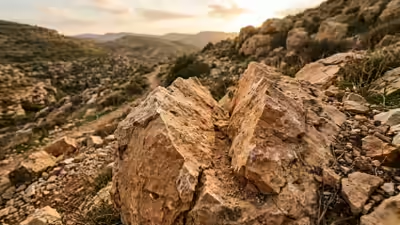
Think about the last time you were under serious pressure. Maybe you calmed down for a minute and then just snapped. Turns out, rocks are pretty much the same. We spent a long time thinking that rocks just broke, without warning. One moment, a hillside is fine, the next it is not. However, a growing body of research is challenging that assumption. Stressed rocks actually give off chemical signals long before they snap. The problem has always been that no one could reliably decode those signals in time to do anything useful.This might be changing.The science behind the “rock stress signal”The basic idea is this: deep inside any rock are tiny pockets of gas trapped in the minerals. Stress builds up, from the weight of water, shifting earth, seismic pressure, and microscopic cracks start to form. At first, they’re barely there, but eventually they open, broaden and link. As that happens, those trapped gases begin to escape through the fractures and make their way to the surface.One of the most trackable of these gases is radon, yes, the same radon that home inspectors test for in basements.According to a study, Probing rock rupture with naturally occurring nuclide signals, a research team has now built a model that maps exactly how these gas signals change as a rock moves through four distinct stages of failure: crack initiation, crack opening, crack dilation, and crack propagation. Basically, they have built a sort of clock that gives them an early warning when rocks are going to break.This isn’t just a lab theoryWhat makes this research exciting is that it not only works under controlled conditions but also in the real world.For three years, the abovementioned research team measured radon emissions from a hillside near a reservoir in the French Alps. They watched a granite cylinder in a laboratory for one month as it weakened and finally broke. In both cases, the signal patterns were consistent with their model.Here’s a little historical data to put it all in perspective: Before the 1995 Kobe earthquake in Japan, a magnitude 7.2 disaster that killed more than 6,400 people, radon levels near the fault spiked noticeably about nine days before the quake struck.Yes, nine days. It’s not nothing.
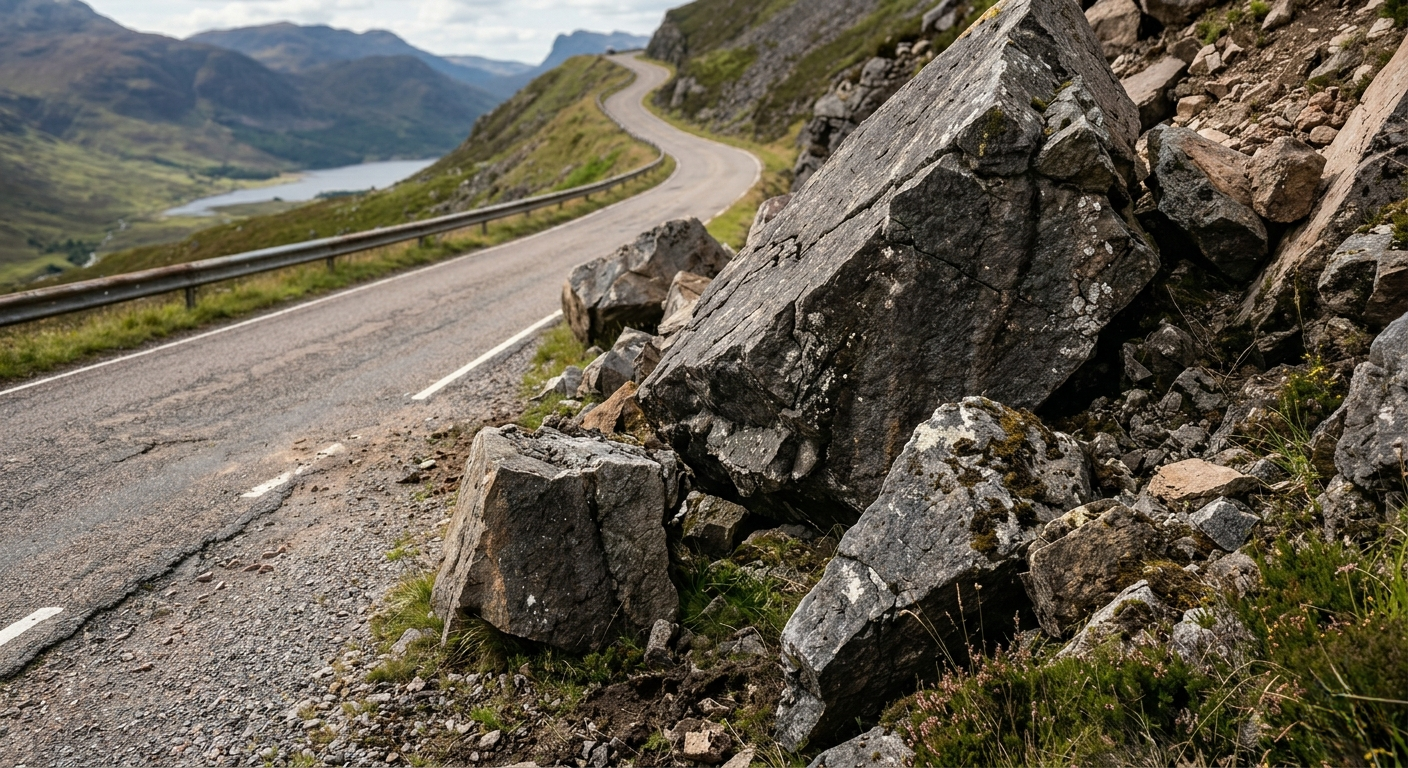
Scientists have mapped four distinct stages of rock failure, each leaving a chemical fingerprint.Image Credits: Google Gemini
Why this matters for the USIf you live in California, the Pacific Northwest, or anywhere on the Wasatch Front in Utah, this research is not only interesting; it’s personal. The US is home to one of the most geologically active regions on the planet. According to the USGS, landslides alone average 25 to 50 deaths per year in the US and cause billions in damage.The dream here is a network of sensors that can pick up these chemical whispers from underground, a real-time alert system that gives communities a window before a slope fails or a fault lets loose. Radon and similar gases travel up from deep within the earth to the surface, so sensors on the surface could theoretically pick up signals from far below what we can see.We’re not there yet, but we’re closerThe researchers admit that there are limitations. Real landscapes are complex. Underground fluids such as hot water or mineral-laden brines can also enhance gas signals, making them difficult to read cleanly. While the model is good at showing what signals look like at various stages, further work is still needed to work out exactly how far in advance those signals appear in the field. The direction is clear, and the tools are getting sharper. The stakes are high, whether it’s a neighbourhood built on a California hillside or a highway cut through mountain terrain, so even an imperfect warning is better than no warning at all. Rocks can seem like the hardest, most impassive things on earth, but they have been sending distress signals to us all along. We are only now learning to listen.