April 11, 2026, 11:52 am

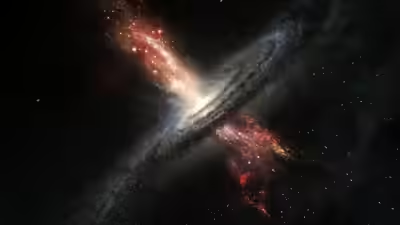
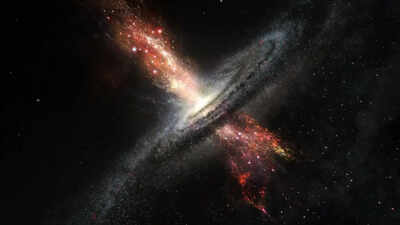
Astronomers have proposed a theoretical model suggesting that the object at the centre of the Milky Way, widely identified as the supermassive black hole Sagittarius A*, could instead be explained by an extremely dense concentration of dark matter. The idea challenges the long-standing interpretation based on observations of fast-moving stars near the galactic core, which have traditionally been used to infer the presence of a black hole with a mass of around four million Suns.
As reported by the BBC, the current research is focused on investigating the possibility that the smaller version of dark matter would create the same effect without a need for a singularity. It will also be interesting to find out whether such a configuration can explain both the behavior of stars near the galactic center and the rotation of the Milky Way. Although the hypothesis is still being considered, it opens another way of understanding the gravitational effect of the object in question.According to the hypothesis, it would be possible to assume that dark matter consisting of fermions would create a very dense core at the center of our galaxy. At the same time, the rest of the dark matter in this model would form a large halo around this core. Consequently, the gravitation of the dense object at the center of the galaxy would explain the high speeds of the nearest stars.
The study argues that the same dark matter configuration could explain the motion of so-called S-stars, which orbit very close to the galactic centre at high velocities. These orbits have long been one of the main pieces of evidence supporting the black hole interpretation. The model extends further by attempting to match the rotation curve of the Milky Way, suggesting that the influence of dark matter could be continuous from the core outwards rather than confined to a central object.
Observations from instruments such as the Event Horizon Telescope have produced images of a bright ring surrounding a dark central region, previously interpreted as the shadow of a black hole. The dark matter hypothesis proposes that a similarly shaped feature could emerge if light is strongly bent around a dense core. In this view, the central darkness would not require an event horizon but could instead result from gravitational lensing effects produced by concentrated dark matter.If the hypothesis were to gain more support through further findings, it would mean that there may be a new interpretation of the galaxy’s structure. Rather than having a single black hole at its center, the core of the Milky Way can be considered the densest region within a wider distribution of dark matter. Consequently, the mechanics of the galaxy must take into account the continuous mass distribution from the center up to the halo.