April 13, 2026, 3:04 pm

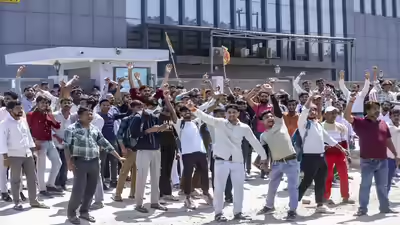
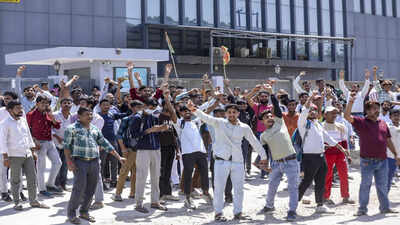
What began as demands for a wage hike by factory workers escalated into violent clashes in Noida on Monday, exposing deep-rooted anger over pay disparities, working conditions and long-pending labour demands. As the workers’ strike continues to unfold, key questions are being raised about how the agitation spiralled into violence, the extent of its impact on commuters, and the security measures being deployed to restore normalcy.The strike has paralysed traffic across major stretches, leaving thousands stranded during the morning rush hour on routes leading into Delhi. Long queues of vehicles stretching several kilometres were seen at the Delhi-Noida border, as workers from multiple industrial units gathered to press for salary revision and raised slogans during the protest. Here’s how it all unfolded:
The agitation began on Monday morning as a peaceful demonstration by workers from multiple industrial units across Noida, including Phase 2, Sector 60, Sector 62 and Sector 84, who had gathered to demand long-pending salary revisions. Workers raised slogans during the protest, with activity also reported at a Motherson company unit, according to PTI, as the agitation spread rapidly across several industrial zones before turning violent, particularly in the Hosiery Complex area of Phase 2.
The protests stem from long-standing discontent over pay disparities, working conditions and unresolved labour demands, with the core trigger being workers’ demand for a wage hike amid rising cost-of-living pressures. Workers have pointed out that stagnant and low salaries are making it increasingly difficult to manage basic household expenses in an inflationary environment. Their demands also centre on improved pay structures, including timely wage revisions and better overall financial conditions to ensure a more sustainable standard of living.
cThe protest, which initially began as a demonstration, escalated after an altercation with police. It quickly turned violent in Phase 2 and Sector 60, with incidents of stone pelting, vandalism and arson reported. The situation intensified as tensions rose between workers and authorities during the agitation.
Both public and private property were damaged during the clashes, highlighting the intensity and spread of the violence. The unrest caused significant damage, with reports of vehicles being torched and at least one car set on fire. Stone pelting was also reported from multiple locations, including within industrial clusters, further escalating tensions on the ground.
Protesters blocked several key routes, including National Highway 9 and the Noida Link Road from Chilla Border in Delhi. The blockade extended across industrial and high-traffic zones, leading to major disruptions on roads connecting Noida and Delhi, as well as spillover impact into Faridabad.
The protests paralysed traffic during the morning rush hour, leaving thousands of commuters stranded. Long queues of vehicles stretched for several kilometres at the Delhi-Noida border. Delhi Traffic Police issued advisories asking commuters to avoid the Chilla Border route and instead use alternatives such as DND via Sarai Kale Khan or NH 24 via Kondli Bridge and Noida Mod. However, the Chilla border later opened for traffic movement.
Security was tightened along Delhi’s key entry points. Police deployed heavy forces across industrial zones under the Gautam Buddh Nagar Commissionerate, with senior officers present on the ground to monitor the situation. Barricading was intensified at key border points, and rapid response teams and paramilitary forces were stationed. Authorities said strict vigil and vehicle checks were being carried out, while coordination continued with Uttar Pradesh and Delhi Police.Police stated that the situation was under control and being continuously monitored. They further added that efforts were made to counsel workers and maintain peace, and that minimum force was being used wherever necessary to maintain law and order. Authorities also appealed to the public not to believe rumours and said normalcy was being restored.
Earlier on Sunday, the administration had announced labour welfare measures including double overtime pay, weekly offs, timely salary payments by the 10th of each month, and bonuses before November 30. District Magistrate Medha Roopam held meetings with industrial representatives to ensure CCTV functionality at gates, maintain workplace safety, and establish grievance redressal systems. A control room with helpline numbers (1202978231, 1202978232, 1202978862, 1202978702) was also set up.
The protests and resulting unrest affected multiple industrial and transport zones across Noida, including Phase 2 (notably the Hosiery Complex), Sector 60, Sector 62 and Sector 84. The disruption also extended to key road networks such as National Highway 9 and the Noida Link Road from Chilla Border, with spillover traffic impact reported in adjoining routes connecting Delhi and even parts of Faridabad.